Wednesday, September 9, 2026
Parenting can be joyful and exhausting within the same hour. Faith-based parenting support gives you space to develop healthier responses, build meaningful relationships, and reconnect with God when parenting stress feels relentless.
Look for a church that combines practical teaching, parent-friendly groups, children’s programs, and recurring service opportunities. At CedarCreek Church, we offer these paths through relevant biblical teaching, groups, age-specific ministries, and local outreach. Visit before committing, then choose one personal-growth activity and one practical way for your family to serve.
Our goal is not to give parents a formula for raising perfect children. We create space where families can know God, find community, and take a practical next step on their faith journey.
Find a Church or Religious Group That Hosts Events for Personal Growth and Community Involvement
Find a church or religious group by evaluating its public calendar, small groups, family programs, volunteer opportunities, and teaching before making a commitment. A strong fit connects personal growth with community involvement through recurring groups, family ministries, biblical teaching, and local outreach.
Start with the organization’s website or app. Look for current dates, clear age ranges, registration details, and contact information. A vague reference to “community” is less useful than a calendar showing when groups meet and how newcomers participate.
Visit one service and one smaller event before deciding whether a church fits your family. During those visits, ask three specific questions:
How often do groups meet, and can parents join after a semester begins?
What screening and check-in practices apply to children’s activities?
Which service projects are suitable for children or whole families?
Pay attention to whether people explain the next step without pressuring you. A healthy environment should give you room to ask questions, learn at a sustainable pace, and participate before taking on a larger commitment.
Our church offers semester-based groups during summer, fall, and winter. Outreach opportunities include Second Saturday Serves, Serve Day, mission trips, CedarCreek Cars, and a Medical Clinic. These options let parents connect spiritual growth with action that addresses local needs.
How Can Church Help Me Become a Better Parent?
Going to church can help you become a better parent by offering biblical wisdom, relationships with other parents, age-specific support, and opportunities to practice compassion as a family. Relevant teaching can bring the Bible into everyday decisions rather than leaving faith disconnected from home life.
Christian parenting advice should do more than tell you to pray harder or try harder. Useful guidance addresses real situations, such as losing your patience, repairing conflict, setting limits, handling busy schedules, and talking about faith without forcing a conversation.
A church community can also interrupt the isolation that intensifies parenting stress. In a group, parents can share what worked, admit what did not, and learn from people in different stages of family life. That support does not replace parental responsibility, but it can replace secrecy and shame with honest relationships.
Our family ministries offer age-specific environments. CedarCreek Kids serves children from birth through fourth grade. Weekend programming serves students in fifth through eighth grade, while Wednesday gatherings serve students in ninth through twelfth grade.
Choose one parenting skill to practice for two weeks rather than attempting a complete family reset. For example, pause for 60 seconds before responding during conflict, apologize without defending your reaction, or schedule a weekly ten-minute check-in with each child.
What Does Faith-Based Parenting Support Look Like During Stressful Weeks?
Faith-based parenting support combines honest prayer, practical emotional regulation, Scripture, restorative conversations, and dependable community. We approach spiritual growth as an ongoing journey, so difficult weeks can become opportunities for connection rather than evidence that you have failed.
Begin by reducing the pressure to solve every problem immediately. When tension rises, name what is happening: “I am overwhelmed, and I need a minute before we continue.” Taking a short pause models self-control without withdrawing from the relationship.
James 1:19 advises believers to be quick to listen, slow to speak, and slow to become angry. Apply that pattern through three deliberate actions:
1. Listen until your child finishes speaking.
2. Repeat the concern in your own words.
3. Respond to the concern instead of reacting to the tone.
Repair matters when you do react poorly. A useful apology names the behavior and the next action: “I yelled, and that was wrong. I am sorry. I am going to calm down, and then we can discuss the rule respectfully.” Avoid adding “but you” to the apology.
Our teaching aims to bring Scripture to life through realistic application. Parents can also seek community through groups rather than carrying stress alone. If parenting stress includes persistent anxiety, depression, or fear of harm, contact a licensed mental health professional or emergency service for focused support.
Christian Parenting Advice for Building Resilience at Home
Christian parenting advice builds resilience when it turns faith into small, repeatable household practices. We encourage people to know God, find community, and take their next step rather than treating growth as a one-time emotional decision.
A short daily rhythm is often more sustainable than an ambitious plan. Choose a consistent point in the day, such as breakfast or bedtime, and spend five minutes on three actions: name one good thing, read a short passage, and pray about one current concern.
Parents can also use questions that invite reflection instead of one-word answers. Ask, “What felt difficult today?” or “Where did you notice kindness?” These questions create space for emotional awareness and spiritual conversation without turning every discussion into a lecture.
Resilient families also repair after conflict. Colossians 3:13 calls Christians to make allowance for each other’s faults and forgive. Forgiveness does not remove household limits. It means correction can happen without humiliation, resentment, or a permanent label based on one mistake.
Try no more than one new household practice at a time. Maintain it for two weeks, discuss what changed, and adjust it together. Consistent five-minute habits usually fit family life better than complicated routines that disappear after several days.
Family Service Opportunities and Personal Growth
Family service opportunities let children see that faith includes noticing needs and responding with compassion. We connect volunteers with community outreach through recurring projects and specialized initiatives, giving families several ways to participate according to age, schedule, and ability.
Service can strengthen personal growth because it shifts attention from abstract lessons to concrete responsibility. A child sorting donations, preparing supplies, or participating in an age-appropriate neighborhood project learns that generosity involves time and action.
Choose the opportunity by asking about four factors: minimum age, adult supervision, physical demands, and time commitment. Do not select a project based only on its emotional appeal. A clearly defined two-hour role may be better for a young child than an open-ended commitment.
After serving, ask each family member three questions: What did you notice? What did you learn about another person’s needs? What should we do differently next time? That brief reflection connects community involvement to spiritual and emotional growth.
How Do I Know Whether a Church Is a Healthy Fit for My Family?
A healthy church fit combines theological clarity, practical support, transparent family practices, welcoming relationships, and realistic participation expectations. We seek to provide a welcoming environment for people at different stages of faith, including those who are skeptical of religion or unsure what they believe.
Compare churches by observing specific evidence rather than relying only on first impressions.
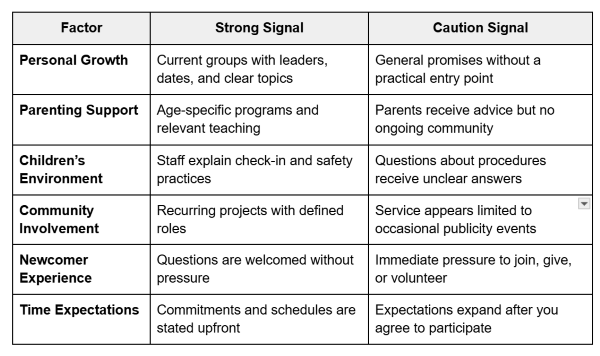
Attend more than once if possible. One visit can show the service format, but a smaller gathering often reveals how people treat questions, disagreements, children, and newcomers.
Choose a church where your family can participate at a sustainable pace. Start with one group or event. Add another commitment only after you understand the schedule and its effect on your household.
Learn More About Our Locations
Why CedarCreek Church for Parenting Support and Community Involvement
We offer relevant biblical teaching, age-specific family ministry, supportive relationships, and practical ways to serve the community. Our mission is to help people meet Jesus and experience the life-changing adventure of following Him.
Our family support spans multiple developmental stages. Children’s ministry serves children from birth through fourth grade. Student environments include weekend programming for fifth through eighth grade and Wednesday gatherings for ninth through twelfth grade.
We also recognize that many people approach church with doubts, difficult experiences, or concerns about judgment. Our welcoming environment, multi-site approach, relevant teaching, and focus on life-change stories are designed for people wherever they are on their journey.
Find Your Family’s Next Step
Choose one next step that matches your family’s immediate need: visit a service, explore a semester-based group, connect your child with an age-appropriate ministry, or join a local service project.
We invite you to experience our community before making a larger commitment. Start with the option that gives your family room to grow in faith and build genuine relationships.
Frequently Asked Questions
Q: I feel like a bad parent. Does that mean my faith is weak?
A: Feeling inadequate does not prove that your faith is weak. Parenting exposes limits, fears, and habits that need attention. Faith offers a framework for honesty, forgiveness, growth, and community, but it does not remove stress or make parents perfect.
Q: Can I attend a parenting group if I do not regularly go to church?
A: Participation rules vary by group, so check before attending. Many church groups welcome people who are exploring faith or returning after time away. Ask whether registration, membership, childcare, or preparation is required before the first meeting.
Q: What should I do after I yell at my child?
A: Calm down, check that everyone is safe, and apologize without blaming your child for your reaction. Name what you did, acknowledge its impact, restate the boundary calmly, and describe how you plan to respond differently next time.
Q: How much time should a family devotional take?
A: A family devotional can take five to ten minutes. Read a short passage, ask one open-ended question, and close with a brief prayer. A simple practice repeated several times each week is usually more sustainable than a long routine.
Q: Can my children volunteer with me at a church outreach event?
A: Children can join some outreach activities, but suitability depends on age, supervision, physical demands, and privacy concerns. Ask the event leader for the minimum age and exact duties. Choose a clearly defined role that your child can complete safely and respectfully.
Q: Do I need to agree with every church teaching before I attend an event?
A: You do not need complete agreement to visit, ask questions, or observe an event. Review the church’s stated beliefs and listen for how leaders handle uncertainty. Avoid settings where sincere questions receive ridicule, pressure, or evasive answers.